Monday, 7 February 2011

Final crit - Collection 100


Written below is exactly what was written on the feedback sheet:


- What is Barney Bubbles?
- The text on the video is not clear
- What is is for?
- Who is your product aimed at? Designers? Music Lovers?


Most of the above is answered by either reading my blog, watching the DVD or referring to the poster in the  packaging.  However to ensure I have addressed these issues please refer below:


1.  The question is not what but who is Barney Bubbles.  I had a chat with Beth about this comment and she said she had actually explained what her product was.  I thought this was a good idea so on the band I put a description of what was inside and that Barney Bubbles was 'the unsung hero of Graphic Design from the 70's and 80's.


2. I have already changed the text to make it more readable and am going to survey ten people to check their opinion. ( The DVD was running on loop in the crit and makes more sense if viewed from the start as this sets the context...) See Design Practise log for details of discussion with Mike Flowers


3. The product is aimed at Graphic designers/record collectors/music lovers as a way of spreading the word about Barney Bubbles.  This was one reason for packaging the product in a single case and also including a poster.  It was important the packaging had the feel that double album's are packaged with good quality stock and lots of images and information to look at. i.e. with add on products.  


Collection 100 - Progress Crit feedback

Issues raised:
- Re-visit the brief - context , target audience, produce, package
- Bring the Barney Bubbles work out in 2D
- Make sure you know who your audience is
- What is the purpose - educational, collector, informative
- Maybe speed the opening sequence up


Actions to be taken


Bring his work out in the 2D packaging
- Confirm works with audience
- Work out purpose


For actions taken see Design practice blog


Saturday, 29 January 2011

Group progress crit for Collection 100

This was our first opportunity after almost four week with this brief to see where everyone was up to and receive some formal feedback.  As a result i went armed with quite a lot of info. including a storyboard and maock up of the product, as per Design Practice blog.  My group was with Amber and included
Will, Beth, Sophie, Luke and Dom.

My moving image idea was enthusiastically received and the group gave me some ideas on developing the packaging including possibly laser cutting a real vinyl single to hold the DVD.  I really liked this concept however given I had not yet produced the moving image I was not sure if there would be time to try this one out. 

Most of the group had carried out copious amounts of research but Beth for example got some useful feedback to develop her product in a way she had not thought of.  Amber stressed to us all the imortance of thinking about our audience.  

Luke's idea for using 100 books to convey the size of the universe was really interesting and we were all fascinated by the fact he had already made so many books! 

Monday, 10 January 2011

Collection 100 -Presentation


This is the feedback I received from my group on the presentation about 100 vinyl album covers.  Overall the feedback was positive, the consensus was that I had chosen and interesting subject and there were several ways I could now take the research. 


OUGD102 Briefs


Tuesday, 14 December 2010

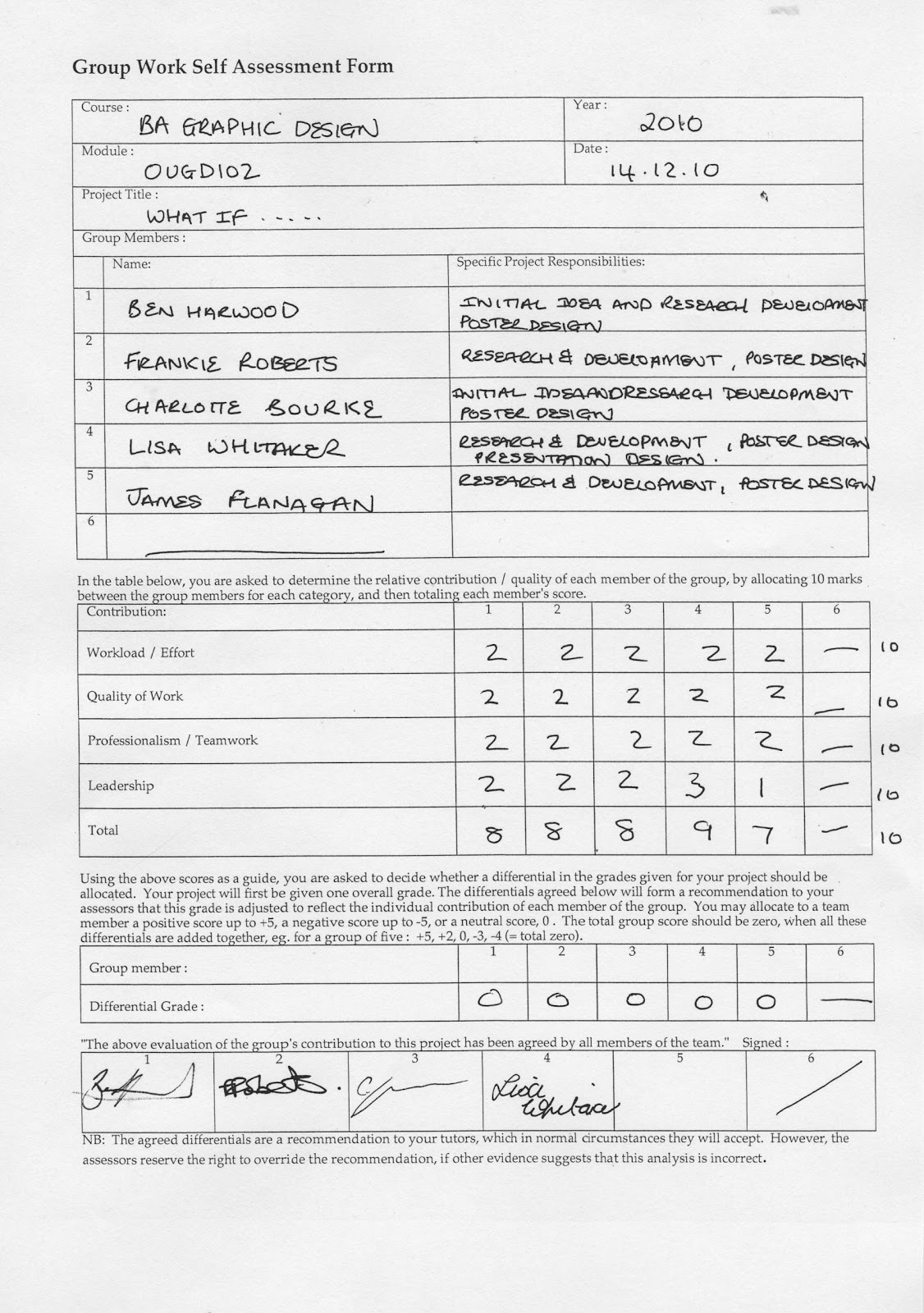
Self evaluation - What if...

The problem we identified from the original Collection 100  research was 'How do we make the people of Leeds aware of how much they are being watched?

The initial research was mainly from Ben and Charlotte as they had collected CCTV research for their collection 100.  We had a collection of about 40 primary source photographs of CCTV camera in and around Leeds City Centre.  As I had not touched on CCTV in my research I went back to the drawing board so to speak and also carried out some research. The evidence I collected included data about the number of cameras in Leeds, the cost of running CCTV to the public, newspaper articles supportive of CCTV.  I also found Leeds Transport website also carries live images from transport CCTV in Leeds. Other primary evidence included the fact that camera were not at eye level and mostly placed at great height.  Also a lot of cameras around Leeds are not identified and often disguised as lights.

Methods used to collect the research included -

Primary research-       Qualitative     - Photographs of live CCTV cameras
                                                       Survey of people's opinions of CCTV cameras
                                                     Walking around Leeds observing where cameras were located, how visible they were and what they looked like

                                  Quantitative  - Counting the number of cameras on a Briggate.


Secondary research -  Qualitative   - Internet - Leeds Council website, council reports, Yorkshire Post which lead to links to Big Brother Watch.  You Tube has a host of CCTV/Big Brother videos.

                                  Quantitative - Internet - Council website - number of cameras, CCTV annual cost, 

One of the most useful methods of research was just walking around Leeds observing the CCTV.  This influenced my 'eye looking' up poster as unless you look up you do not notice the cameras at all. This also helped us negate the Pavement advertising idea as what is the point of trying to encourage people to look down when we really wanted them to look up!.  
One You Tube video we watched also proved how strongly people feel about CCTV and in a way they were trying to raise awareness. The women in the video was 'holding' the poster and the whole thing immediately felt more personal and engaging.  Ben and I both hooked into this idea which lead to the outcome.

Unfortunately with time constraints in the second week we were not able to carry out a primary quantitative survey of the public.  The biggest learning point of the whole brief for me, rather than going out armed with a clipboard and pen to ask the public questions just take a camera and hold some engaging posters up.  A large number of people stopped to look and some asked us what we were doing.  Unfortunately there was only really time to record us in the street with the posters.  With more time I would have liked to have formulated a simple question about CCTV to establish of one hundred people how many were aware of the cameras we identified.

Five things I have learnt about the design process over the last two weeks


  1. The importance of a team when evidencing work - You can't take photos and hold posters up.  
  2. The importance of a team when there are several tasks to be carried out in a short space of time 
  3. Having a wide range of different types of research informs both the identification of the problem and in turn the solution.


Five things I would do different next time


1.  Formulate a questionnaire for primary research early on so this can inform the outcome.
2.  Be bolder with solutions, why not video instead of photographs?
3.  We all produced posters to use on the hitting Briggate exercise.  On reflection we would have made more impact if we had chosen one strong design from these to use for all the posters
4.  As far as the starting point for Collection 100 Photos, after seeing he interesting images other people had produced I would try to think outside the obvious next time.
5.  


What if....group work self assessment form